Claude Skills & Hooks
daily driverThe custom playbooks and automatic triggers that shape how your AI assistants think and behave.
Skills are reusable mini-playbooks the AI can invoke, like calling a named procedure instead of reinventing it every time. Hooks are little automations that fire automatically on events, before you even type a word. Together they let you tune your AI assistants to work exactly the way you want.
- Python
- Markdown
- Claude Code
- JSONL
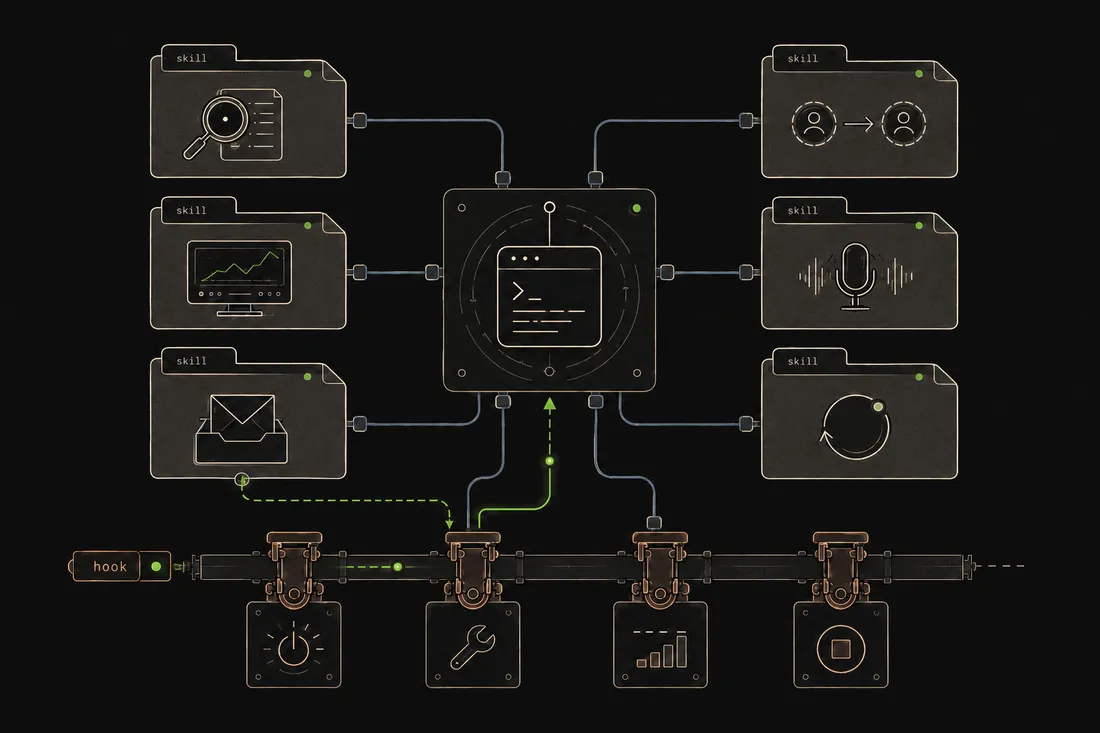
The neat part is that this is basically a personality and behavior layer built on top of a general-purpose AI. When you type /deeper-research, the assistant knows to fan out multiple parallel sub-agents, cross-check sources, and return a cited report, not just Google something. When a session starts, a hook silently arms the inbox so messages from other sessions can arrive live. When tokens run low, another hook fires a compaction agent in the background before anything important is lost. None of this required you to patch the AI itself; it's all wiring on the outside, in plain text files you can edit and version.
What it does
Skills live as text files in ~/.claude/skills/. Each one is a self-contained playbook with a name, a description, and step-by-step instructions. When you type /agent-monitor, the AI loads that skill and follows it - reviewing all running external agents, checking for stalls, and producing a status summary. When you type /prepare-handoff, the skill walks through creating a full context document and exporting the session before the token window runs out. The AI doesn't have to figure any of this out from scratch. Hooks are Python modules that run automatically at specific moments: when a session starts, before or after a tool call, when a session is about to stop. The inbox monitor hook creates each session's message inbox and signals the AI to start watching it. The startup enforcer hook makes sure the AI always initializes Coderoo before doing anything else. The Signal message hook injects any waiting Signal messages into the conversation at the start of each turn. The background compaction hook watches token counts and fires a summarizer before anything gets dropped.
Why it's neat
Skills = reusable playbooks
One slash command kicks off a whole multi-step workflow that the AI already knows how to run - research, monitor, handoff, and more.
Hooks = automatic behavior
Events like "session started" or "about to stop" silently trigger Python scripts that keep sessions healthy without any extra commands.
All version-controlled plain text
Every skill and hook is a file you can read, edit, and commit - no magic, no black boxes.
How it works
Fans out multiple parallel web-research agents, cross-checks claims across sources, and returns a cited report instead of a single search result.
Surveys all running external agent sessions, detects stalls or idle prompts, and produces a consolidated status dashboard.
Creates a comprehensive context document and exports the full session transcript before starting fresh, preventing context rot from automatic compaction.
Audits every active Claude Code session across all terminal windows and flags stalled or directionless work.
Guides the design of a new Claude Code sub-agent using research-backed principles, from requirements through the finished agent file.
Fires on every session start; creates the personal inbox file and signals the AI to arm its live message-tail before the first prompt.
Blocks any tool call until the AI has initialized Coderoo, enforcing a consistent startup order across every session.
Watches token thresholds across the conversation and launches a background compaction agent to summarize history before the context window fills up.